
Air Plug Gauges

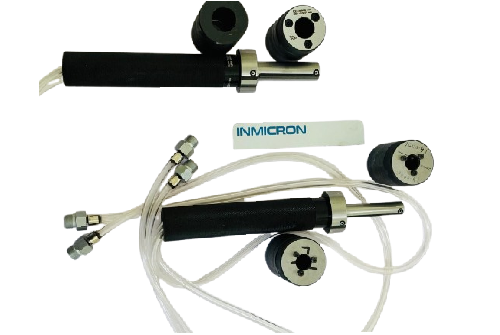
An air plug gauge is a precision measuring instrument used primarily to measure the internal dimensions (such as diameter or width) of a workpiece, especially for holes, bores, and other cylindrical features. Unlike traditional plug gauges, which rely on direct mechanical contact, air plug gauges use air pressure to check the size of a hole. The gauge is designed to pass air through a calibrated hole, and based on the airflow (or restriction), it determines whether the hole is within tolerance.
Uses of Air Plug Gauges:
Air plug gauges are primarily used to measure the internal diameter of holes and bores in a workpiece. The air pressure response gives a quick and accurate indication of whether the hole is too large, too small, or within the required tolerances.
These gauges are widely used in quality control and inspection processes, especially when it is critical to measure internal dimensions with high accuracy. The use of air for measurement can be more sensitive and accurate compared to mechanical gauges in some applications.
Air plug gauges are ideal for high-volume production environments. They can quickly verify the dimensions of hundreds or thousands of parts in a short amount of time, which is particularly useful in industries such as automotive, aerospace, and manufacturing.
Air plug gauges are particularly useful for checking the tolerances of internal features such as keyways, bores, and bearing housings, where precise internal geometry is crucial for proper functioning.
They are versatile in that they can be used to measure both small holes (e.g., in fine mechanical components) and larger holes (e.g., in industrial parts like cylinders or engine blocks) with a high level of accuracy.
Air plug gauges are used to check for bore distortion or irregularities in the roundness of a hole. They can quickly reveal if a bore has any out-of-round or tapered conditions, which would affect the fit of parts like pins or shafts.
Air plug gauges are often used for the calibration of CNC machines, boring machines, or other equipment that produces internal dimensions. They ensure that the machine is accurately producing holes within the specified tolerances.
In industries where components undergo wear and tear, air plug gauges can help inspect the internal dimensions of used parts to determine if any dimensional changes have occurred due to wear or environmental conditions.
Advantages of Air Plug Gauges:
Air plug gauges provide very high precision and sensitivity when measuring internal diameters. The air pressure method can detect even small variations in the hole size, making it ideal for applications requiring tight tolerances.
Unlike traditional mechanical plug gauges, which require direct contact with the workpiece, air plug gauges offer non-contact measurement. This means that there is no risk of damage to the part being measured, and wear on the gauge itself is minimized.
Air plug gauges are fast and efficient, making them highly suitable for mass production environments where parts need to be inspected quickly. The air pressure is quickly analyzed to determine if the hole meets the required dimensions, significantly reducing inspection time.
Since air plug gauges don’t physically touch the part (in the sense that traditional gauges do), they experience much less friction and wear. This leads to longer service life for the gauges and avoids the need for frequent recalibration or replacement.
The non-contact nature of air plug gauges means there is no risk of marring or damaging the workpiece, which is important when inspecting delicate or high-value components that need to remain intact for use or further processing.
Air plug gauges can be used to measure a wide range of internal dimensions, from small holes in fine mechanical components to larger bores in industrial equipment. This makes them versatile across various industries and applications.
Air plug gauges are often integrated into automated inspection systems. The use of air pressure measurement can be easily incorporated into robotic or conveyor systems for real-time quality control in high-volume manufacturing processes.
The operation of air plug gauges is relatively simple and does not require highly specialized skills or training. The air pressure is usually analyzed through a straightforward digital or analog readout, allowing operators to quickly assess whether the part is within specification.
Since the gauge does not physically contact the surface of the bore, there is no risk of abrasion or wear on the internal surface of the hole being measured. This is particularly important in industries like aerospace or automotive, where surface integrity is crucial.
Air plug gauges often come with calibration standards that make it easy to verify their accuracy and ensure consistent performance over time. Additionally, they require minimal maintenance because there is no direct mechanical contact with the part, reducing the potential for degradation.
Air plug gauges are generally compact and lightweight, which makes them easy to handle and use in confined spaces or for portable inspection tasks.
Since air plug gauges don’t physically push against the part, they don’t risk causing any deformation or damage to delicate parts, which can be a concern with traditional mechanical plug gauges.
Conclusion:
Air plug gauges are highly effective tools for measuring the internal dimensions of parts with great accuracy, speed, and ease. Their non-contact measurement method, high precision, and ability to inspect parts without causing damage make them especially suitable for industries that require fast, high-volume, and precise hole size measurements. The advantages of air plug gauges, such as reduced wear, high sensitivity, and minimal maintenance, make them indispensable in quality control, manufacturing, and machine calibration applications. Whether for mass production, prototyping, or maintenance, air plug gauges offer an efficient, reliable, and cost-effective solution for ensuring dimensional accuracy.